Sewer line problems can quickly become some of the most disruptive plumbing issues a homeowner faces. Slow drains, recurring backups, sewage odors, unusually wet areas in the yard, and damaged underground pipes can all point to a problem with the main sewer line.
The good news is that not every sewer problem requires a complete replacement.
Whether your sewer line needs repair or replacement depends on the location of the damage, the condition of the pipe, the cause of the problem, and how much of the line is affected.
For homeowners in Marietta, GA, identifying sewer problems early can help reduce damage and give your plumber more repair options.
What Does Your Main Sewer Line Do?
Your home’s main sewer line carries wastewater from toilets, sinks, showers, tubs, washing machines, and other plumbing fixtures away from the property.
Most homeowners rarely think about this pipe because it is usually buried underground and out of sight.
That changes quickly when something goes wrong.
A damaged or blocked sewer line can interfere with several plumbing fixtures at the same time, which is one reason recurring problems throughout the house deserve professional attention.
What Are the Warning Signs of a Sewer Line Problem?
Sewer line problems often provide warning signs before a complete failure occurs.
Watch for symptoms such as:
- Multiple drains running slowly
- Toilets, tubs, or showers backing up repeatedly
- Gurgling sounds from drains or toilets
- Sewage odors inside or outside the home
- Water backing up in one fixture when another is used
- Recurring drain clogs
- Unusually wet or soft areas in the yard
- Areas of grass that are noticeably greener than the surrounding lawn
- Standing water where the sewer line runs
- Indentations or sinking areas in the yard
One clogged sink does not necessarily mean your sewer line is damaged.
When several fixtures begin having problems at the same time, however, the main sewer or drainage system becomes a more likely place to investigate.
Why Do Sewer Lines Fail?
Several different problems can damage or restrict a residential sewer line.
Understanding the cause matters because the best repair depends on what is actually happening underground.
Tree Root Intrusion
Tree and shrub roots naturally grow toward sources of moisture.
If an older sewer line develops a crack, loose joint, or other opening, roots may enter the pipe and continue growing inside it.
Over time, root intrusion can restrict wastewater flow and contribute to recurring backups.
Aging or Deteriorated Pipes
Sewer pipes do not last forever.
Older materials can deteriorate, corrode, crack, separate at joints, or become structurally compromised as they age.
The condition of the entire pipe should be considered when deciding whether a localized repair is enough.
Shifting Soil
Ground movement can place stress on underground plumbing.
Soil settlement, erosion, construction activity, and other changes around the property may cause sections of sewer pipe to shift, separate, or lose their proper slope.
Grease and Debris Buildup
What goes down your drains eventually reaches the sewer line.
Grease, fats, oils, wipes, hygiene products, and other inappropriate materials can accumulate inside the drainage system and contribute to blockages.
Crushed or Collapsed Pipe
A badly damaged pipe can partially or completely collapse.
When the structure of the pipe has failed, cleaning the line will not correct the underlying problem. Repair or replacement may be necessary.
Why a Sewer Camera Inspection Is So Valuable
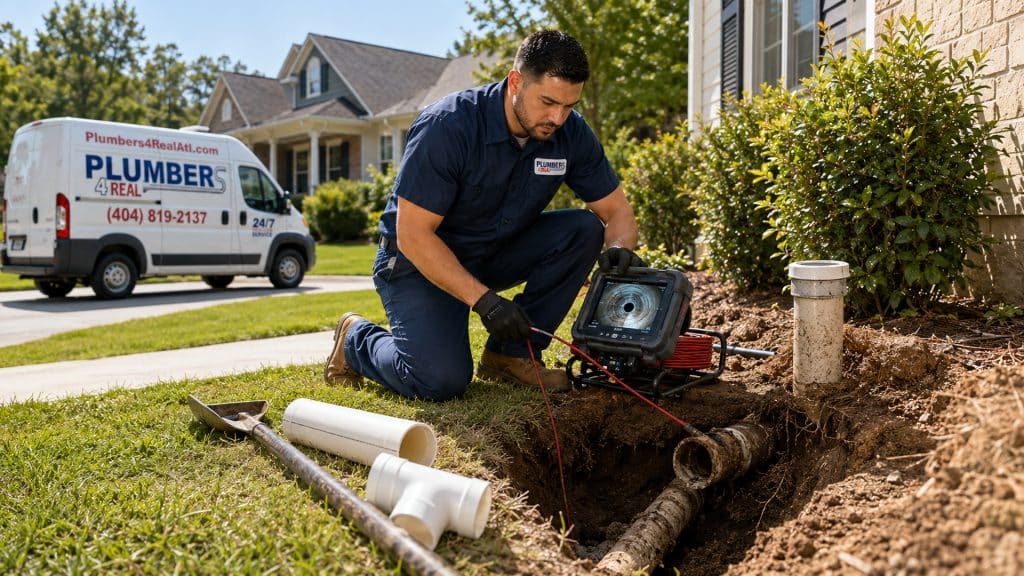
One of the most useful tools for diagnosing a sewer problem is a professional video camera inspection.
A specialized camera is inserted into the drainage system so the plumber can inspect the inside of the sewer line.
A camera inspection may reveal:
- Tree roots
- Heavy buildup
- Cracks
- Broken pipe
- Separated joints
- Corrosion
- Obstructions
- Collapsed sections
- Other visible damage
This information helps determine whether the problem can be cleared, repaired locally, or requires more extensive sewer line replacement.
Instead of making assumptions based only on symptoms above ground, the plumber can see what is actually happening inside the pipe.
When Can a Sewer Line Be Repaired?
A sewer line repair may make sense when the damage is limited to a specific portion of an otherwise serviceable pipe.
Examples may include:
- One damaged section
- A localized crack
- A separated connection
- Limited root intrusion
- An isolated obstruction
- Damage confined to a relatively small area
The condition of the surrounding pipe matters.
Repairing one section of sewer line makes more sense when the remaining system is still in reasonable condition.
If the entire pipe is severely deteriorated, repeatedly repairing individual sections may simply postpone a larger replacement project.
When Does a Sewer Line Need to Be Replaced?
Replacement may be recommended when the sewer line has widespread structural problems or has reached the point where localized repairs are unlikely to provide a reliable long-term solution.
Situations that may lead to sewer line replacement include:
- Multiple damaged sections
- Significant deterioration throughout the pipe
- A collapsed sewer line
- Severe root intrusion
- Repeated failures after previous repairs
- Extensive cracks or breaks
- Poorly aligned or separated pipe sections
- An older sewer line with widespread structural problems
The goal should not simply be to stop today’s backup.
A good sewer evaluation should also consider whether the proposed solution makes sense for the overall condition of the system.
Sewer Line Repair vs. Replacement: What’s the Difference?
The basic distinction is straightforward.
Sewer line repair addresses a specific damaged portion of the system.
Sewer line replacement replaces a larger section or the entire affected sewer line.
Neither option is automatically better.
The right choice depends on the condition of the pipe.
A localized repair may be more practical when most of the sewer line is healthy. Replacement may provide better value when deterioration or structural damage extends through much of the system.
Can a Clogged Sewer Line Be Cleaned Instead of Replaced?
Sometimes.
A blockage caused primarily by buildup or debris may be resolved through professional drain or sewer cleaning.
Hydro jetting, for example, uses high-pressure water to remove certain types of buildup and obstructions from plumbing lines.
But cleaning cannot repair a pipe that has collapsed, cracked extensively, or suffered serious structural damage.
This is why diagnosis matters.
The first question should not be, “How do we clear this line?”
It should be, “Why is this sewer line having problems?”
What Is Trenchless Sewer Line Replacement?
Traditional sewer replacement may require digging a trench along the path of the damaged pipe.
Modern trenchless methods can sometimes reduce the amount of excavation required.
Depending on the property, pipe condition, access, and other factors, trenchless techniques may use limited access points rather than exposing the entire sewer line.
Potential benefits can include:
- Less excavation
- Reduced disruption to landscaping
- Less disturbance to driveways or walkways
- Faster restoration of the affected area
- Fewer areas of the property that need to be rebuilt afterward
Trenchless replacement is not appropriate for every sewer problem.
A professional evaluation is needed to determine whether the existing pipe and property conditions make it a practical option.
What Is Pipe Bursting?
Pipe bursting is a trenchless replacement technique that replaces an existing underground pipe while using much of the same path.
Specialized equipment breaks or displaces the old pipe while pulling a replacement line into position.
Because access can often be created at limited points, pipe bursting may reduce the need for a continuous open trench across the property.
What About Sewer Pipe Lining?
Some sewer conditions may be candidates for rehabilitation methods that create a new pipe surface within the existing line.
Whether lining makes sense depends on factors such as the condition, shape, accessibility, and structural integrity of the existing sewer pipe.
A severely collapsed or improperly aligned line may require a different approach.
How Do You Know Which Sewer Solution You Need?
The best sewer repair plan should be based on evidence rather than guesswork.
A professional evaluation may consider:
- Camera inspection findings
- Location of the problem
- Length of damaged pipe
- Pipe material
- Age of the sewer system
- Severity of structural damage
- Previous sewer repairs
- Root intrusion
- Accessibility
- Landscaping and hardscape above the line
- Recurring history of backups
Once the condition of the pipe is understood, your plumber can explain which options are appropriate.
How Can You Help Prevent Sewer Line Problems?
You cannot prevent every underground plumbing problem, but good habits can reduce unnecessary strain on the sewer system.
Only Flush Appropriate Materials
Toilets are designed primarily for human waste and toilet paper.
Avoid flushing items such as:
- Wipes
- Paper towels
- Feminine hygiene products
- Cotton products
- Dental floss
- Diapers
- Household trash
Even products marketed as flushable can contribute to drainage problems.
Keep Grease Out of Kitchen Drains
Cooking grease, fats, and oils should not be poured down the drain.
These materials can cool and accumulate inside plumbing lines, where they may combine with other debris.
Pay Attention to Recurring Drain Problems
One isolated clog may be a fixture-level problem.
Repeated clogs or problems affecting multiple fixtures deserve more attention.
Do not repeatedly treat a larger sewer problem as though it were simply another clogged drain.
Think About Tree Placement
Large trees and shrubs can develop extensive root systems.
When planning new landscaping, consider where underground utilities and sewer lines are located.
Address Small Problems Early
Recurring gurgling, slow drains, sewer odors, and backups are worth investigating before they turn into a larger failure.
Early diagnosis can often provide more options than waiting until the sewer system stops functioning completely.
Is a Sewer Backup an Emergency?
It can be.
A sewer backup becomes particularly urgent when wastewater is entering the home.
Stop using affected plumbing fixtures if sewage is backing up through toilets, tubs, showers, or floor drains.
Continuing to use water throughout the house can add more wastewater to a blocked drainage system.
Prompt professional attention is especially important when:
- Sewage is entering living areas
- Multiple fixtures are backing up
- Toilets cannot be used
- Wastewater is spreading across flooring
- The sewer system appears completely blocked
Frequently Asked Questions About Sewer Line Repair and Replacement
How do I know if my main sewer line is clogged?
Multiple slow drains, recurring backups, gurgling toilets, sewage odors, and water appearing in one fixture when another fixture drains can indicate a main sewer problem.
Do tree roots mean my sewer line has to be replaced?
Not automatically. The severity of the root intrusion and the condition of the pipe need to be evaluated. Some situations may be manageable with cleaning or localized repair, while severely damaged lines may require replacement.
Can a sewer camera tell if the pipe is broken?
A sewer camera inspection can help a plumber visually identify many problems inside the line, including cracks, root intrusion, obstructions, separated joints, and some types of structural damage.
Is trenchless sewer replacement better than digging?
Trenchless methods can reduce excavation when the property and pipe conditions allow them. Traditional excavation may still be necessary in some situations. The best method depends on the specific sewer line.
Should I repair or replace an old sewer line?
Age alone does not determine the answer. The overall condition of the pipe, number of damaged areas, repair history, and severity of deterioration should guide the decision.
How serious is sewage backing up into the house?
Sewage entering a home should be treated as an urgent plumbing problem. Stop using affected fixtures and contact a professional plumber.
Need Sewer Line Repair or Replacement in Marietta, GA?
Recurring sewer problems are not something homeowners should have to keep guessing about.
Plumbers 4 Real provides sewer camera inspections, sewer line repair, sewer line replacement, hydro jetting, and trenchless sewer solutions for homeowners and businesses throughout Marietta and surrounding communities.
A professional inspection can identify what is happening underground and help determine whether your sewer line needs cleaning, repair, or replacement.
For sewer line service in Marietta, GA, call Plumbers 4 Real at 404-819-2137.